Keepsake
Oct 13 2020
Keepsakes,
kept
by
the sentimental
or
those who can't let go.
By
peddlers in posterity,
who
believe in their heart
memory
lives on.
In
my parents' basement
old
report cards are squirrelled away.
Some
busted trophies
from
minor triumphs
reside
on a dusty shelf.
And
tossed in a box
are
some black-and-white photos without captions or dates,
once
thought worth saving
but
now gone to waste.
And
the old bedroom
that's
still just as I left it,
a
museum of my childhood
I'm
more or less embarrassed by.
Mementos
kept
for
the sake of what?
Enigmatic
reminders
of
a time that's lost?
Offerings
to
the god of self-importance?
Or
our aging folks
at
the stage of life
when
they're doggedly searching for meaning,
have
invested their dreams
in
us?
But
there is no posterity.
Because
we are soon forgotten,
as
were all of those
who
came before.
Because
our descendants
will
be just as self-absorbed.
And
because our dreary mementos
will
fade
tarnish
gather
dust,
then
be lost in the fire
or
left at the curb.
So
live in the moment, I say;
it's
all we really possess.
And
choose which
of
the infinite futures
you
will seize for yourself.
The past is unreliable,
not only composed of half-remembered confabulations, but slightly
remade each time it's recalled.
And
the future — despite the definite article — is not singular, it's
infinite: it hasn't happened yet; it's all hypothetical. So there is
no such thing as “the future”.
So
the present is really all there is. My dogs, who are masters of Zen,
know this innately. They inhabit the present, fully and unthinkingly.
One of the many things I admire about them.
I'm
not at all sentimental. I try to keep my writing, but am attached to
nothing else. So I persist in archiving and backing-up, even though
I know what an illusion the notion of posterity is. I find a becoming
humility in accepting this. It acknowledges not only one's lack of
importance, but one's utter insignificance: again, to invoke
philosophy, the dissolution of the boundaries of ego.
This
poem began with a personal essay (a feature they call “First
Person”) in today's Globe and Mail (Oct 13 2020). It's not
at all the best written piece I've read there. But I include it for
anyone interested in the mysterious alchemy of inspiration.
Elaine
McShane hopes her son-in-law’s old trophies will be loved by
someone new
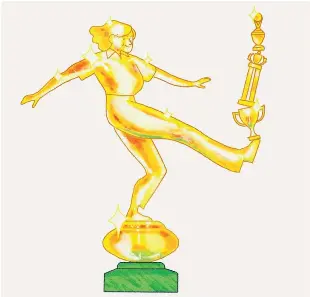 ILLUSTRATI
ON
BY DREW SHANNON
Sometimes
parents are so attached to the memories of past victories they store
the old trophies in their basement; it can be more meaningful to them
than to their children, Elaine McShane writes
They
sat on the curb, spilling higgledy-piggledy out of a slumping box,
dirty and dusty from years spent in the garage, neglected and
abandoned by their owner. Matthew’s boyhood trophies, glories from
his years of playing badminton and soccer, were the last remaining
trace of moving day. I was cruising past my daughter and son-in-law’s
home hoping to catch one last glimpse, say one final goodbye before
they left. But the moving truck had gone. The street was silent, the
driveway empty. Feeling bereft and sad, I could not help myself. I
wrestled the heavy box and its contents into the trunk of my car and
brought them home.
For
my son-in-law, it was hard to discard nearly 50 soccer and badminton
trophies, to set them out for the garbage. These were reminders of
games in which he excelled. Now they became keepsakes no longer kept
for the sake of keeping. Out they went. He saved his medals, easier
to store, but moving house meant it was time to downsize, to make
some difficult decisions.
Matthew’s
first trophy was awarded when he was six and his last - at 18 - was
when he stood runner-up National Badminton Champion in a Quebec City
tournament. The progression of his successes was recorded on all the
metal trophy plates. These records of time, energy and competition
represented years of his parents’ dedication to his interest in
sports.
Parents
invest much time and energy in their kids’ games. Their social life
can revolve around their children’s sport, and tournaments in
distant cities are occasions to travel. Sometimes parents are so
attached to the memories of past victories they store the old
trophies in their basement; it can be more meaningful to them than to
their children.
Matthew’s
dad was a soccer coach for many years, then Matthew followed suit and
coached teams for his own children, as have my two other sons-in-law
in sports that engaged them in their youth. What will happen to their
trophies?
Over
the next few days I cleaned and shined. I catalogued the information
on the metal plates in order of year, and set the trophies on the
dining room table, itself polished to a high shine, the better to
display them. The soccer awards were most distinctive and
action-packed. Topping a high base, often being a cup, a figure
kicked high, arms outstretched, with the soccer ball attached to the
toe. Several needed slight repairs, which I undertook before
photographing them. Two of the wooden badminton awards, I noticed,
were created in the shop program of a Timmins high school, no less
rewarding for their simplicity and distinctive for their heft. Who
wouldn’t covet a trophy like these on their shelf, whether earned
or not? I chose five distinctive ones for myself and displayed them
on my book case.
In
anticipation of Val and Matthew’s visit the following week, the
container pots out front sported two tall matching trophies as
centrepieces. Their striking emerald-green bases rose eye-catchingly
above the colourful flowers. Matthew noticed right away. Liking my
design, he took them home.
I
sometimes wonder if there is a resting place for trophies that
belonged to children who have become adults? Like the elephant’s
graveyard, it is a mythical location that does not exist. Shelves,
basements, thrift shops, the curbside, fulfill such purpose.
Sometimes sports clubs will purchase old trophies, remove the
nameplates and reuse them. I could not find a trophy shop that would
repurpose Matthew’s haul. And a thrift shop did not seem like a
respectful place for these honours.
And
yet, while thrifting last summer, I remember a young lad asking the
shopkeeper if there were any trophies on sale. He had purchased
several a few weeks before and wanted more to display on his shelf.
The allure of trophies, for him, could be a substitute for winning,
perhaps representing aspirations of triumph and success. Or was he
jealous of friends who had their own hardware? Maybe these
masterpieces of design were desirable for their appearance. And what
luck if the inscribed name happened to be a famous athlete from the
past.
In
the end, I couldn’t keep Matthew’s old treasures. Instead, I
found small boxes that would each hold five or six trophies. One by
one, the boxes sat on the curb, on the route many children used on
their way to and from school. Passersby could see these gleaming
statues, as could I from my kitchen window. When one box disappeared,
another took its place.
I
watched a young boy wobble up the street on his bicycle, trying to
balance with several trophies under his arms. I saw a mother carried
trophies as she walked her boy to school. Two youngsters came to the
door, asking me to set a box aside for them to collect on the way
home. My hope is that Matthew’s trophies are a risen-from-the-grave
story, that they will be recycled, reused, restored to their former
glory and pride, and sit on display for a time.
By
the end of the day, the trophies were gone. The last empty box lay on
the side of the road, overturned by the wind.
The
progression of his successes was recorded on all the metal trophy
plates. These records of time, energy and competition represented
years of his parents’ dedication to his interest in sports.


